Author: Artur P. | Powder coating shop owner, 15 years of experience | Reading time: 10 minutes
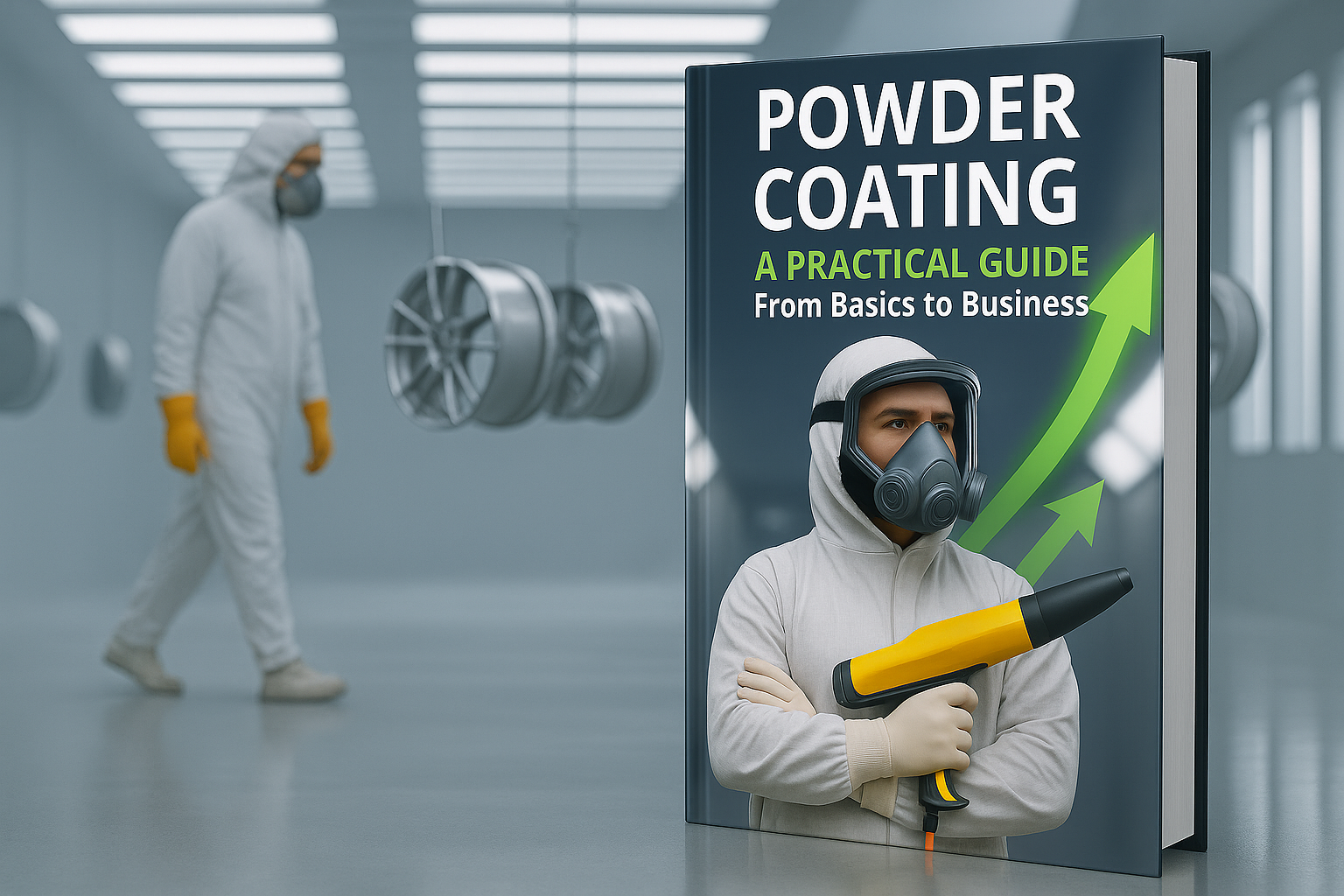
Powder Coating Guide for Beginners – Practical Manual from a Working Shop Owner
If you’re searching for a powder coating guide, you’re probably in one of three situations: you’re just starting out and want to learn the process from scratch, you’re already coating but running into problems you can’t solve, or you’re thinking about opening your own powder coating shop and need to know if the numbers actually work.
I’ve been running a powder coating shop for 15 years. This guide — and the practical manual behind it — is everything I wish someone had handed me on day one.

Why Most Powder Coating Guides Don’t Actually Help
There are two kinds of powder coating information available online: manufacturer marketing material that makes everything look easy, and academic textbooks written for industrial engineers. Neither helps someone who needs to know why their coating is peeling off aluminum wheels on a Tuesday morning.
This manual is different. Every procedure in it has been tested in a real production environment — including the mistakes that cost me and my customers thousands of dollars. I write about those too.
What Is Powder Coating? The 4-Step Process
Powder coating is an electrostatic finishing process where dry powder is applied to a grounded metal part, then cured in an oven to form a hard, durable surface. No solvents, no drips, no toxic fumes during application.
The process has four stages — and problems in any one of them will ruin the final result:

1. Surface Preparation — degreasing, blasting, conversion coating. This is where 80% of coating failures originate. Most guides spend two paragraphs on this. My manual dedicates an entire chapter with specific parameters for steel, aluminum, galvanized steel, and stainless.
2. Application — electrostatic gun settings, voltage (kV), current (μA), airflow, gun distance, cross-hatch technique. The manual includes specific voltage, current, and gun distance parameters for flat surfaces, profiles, and hard-to-reach areas — with recommendations for corona and tribo guns from brands like WAGNER, NORDSON, and GEMA.
3. Curing — temperature, time, oven airflow. Undercure and overcure both destroy adhesion in different ways. The difference between 356°F and 392°F (180°C and 200°C) matters more than most people realize.
4. Quality Control — cross-hatch adhesion test, coating thickness measurement, visual inspection. Chapter 16 (Troubleshooting) covers solutions to 95% of the defects you’ll encounter.
Powder Coating for Beginners – What You Actually Need to Know First
Equipment Selection
The manual starts here because buying the wrong gun or oven before you understand the process is an expensive mistake. Chapter 2 covers oven types and sizing, transport systems, and booth selection. Chapter 3 goes deep on compressed air quality — the invisible factor behind most fish-eye defects. Chapter 5 is dedicated entirely to grounding, the most overlooked cause of poor powder adhesion.

Compressed air quality alone causes more coating defects than any other single factor. Oil or moisture contamination in your air supply creates fish-eye craters that appear after curing — when it’s too late to fix without stripping and starting over.
The Electrostatic Process Explained
The powder sticks to the part because of electrostatic attraction — the gun charges powder particles negatively, the grounded part attracts them. The Faraday cage effect causes problems in recessed areas where charged particles repel each other instead of reaching the surface.

Understanding the physics means you can adjust gun settings intelligently instead of guessing.
Specialist Techniques Not Covered in Most Powder Coating Guides
Aluminum Wheels – The Hot Coat Method
Aluminum wheels are one of the most common and most problematic powder coating jobs. The manual dedicates a full chapter to this, including the hot coat method: preheating wheels to 300–390°F (150–200°C) for 10–15 minutes before application. The powder applied to the still-hot wheel immediately begins to melt and partially fuse with the surface — resulting in significantly stronger adhesion, better coverage of recesses between spokes, and thicker coatings achievable in a single pass.

Standard iron phosphating destroys adhesion on aluminum — the manual explains why and what to use instead: zirconium-based conversion coating, which works on steel, aluminum, and zinc at lower temperatures and meets modern environmental regulations.
Galvanized Steel – Outgassing Protocol
Galvanized steel requires a specific outgassing step before powder application: 374–428°F (190–220°C) for 45 minutes. Skip this and zinc gases will push through the coating during cure, creating craters that look like contamination but aren’t.
Stainless Steel – The 2-Hour Window
After surface preparation, stainless steel must be powder coated within 2 hours. The oxide layer reforms quickly on stainless — wait longer and adhesion drops significantly.
Powder Coating Troubleshooting – The Most Common Problems
After 15 years in a production shop, I’ve seen every defect multiple times. Chapter 16 of the manual covers:
Coating peeling or flaking — almost always a surface preparation failure. The manual gives a diagnostic checklist to identify exactly which step failed.
Orange peel texture — gun distance, airflow, or curing temperature. Each cause has a different fix.
Metallic powders showing streaks — technique issue. The manual covers the specific cross-hatch pattern and gun angle that eliminates this.
Fish-eye craters — contamination. Usually compressed air oil or silicone from a previous job. Prevention protocol included.

The cross-hatch adhesion test tells you immediately whether your surface preparation worked. The manual explains how to read the results and what to do when they fail.
Buy the Complete Powder Coating Manual – $27 →Starting a Powder Coating Business – What the Numbers Actually Look Like
Chapter 13 covers what most guides completely ignore: the business side.
Most small powder coating shops don’t know they’re working at a loss. They calculate powder and electricity costs, ignore labor properly, and forget about equipment depreciation, compressed air costs, and the time spent on rework. The manual includes a real cost calculation model built from 15 years of actual shop data.
Topics covered: realistic job pricing, where to find your first customers, managing seasonal demand swings, and why some shops fail despite being fully booked.
What’s Inside the Manual – 130 Pages, 16 Chapters

Part I – Fundamentals
- Chapter 1 – What is powder coating? The technology and how it works
- Chapter 2 – How to start your powder coating journey: where to begin
- Chapter 3 – Compressed air in the coating shop: the invisible factor that ruins coatings
- Chapter 4 – Surface preparation: the foundation everything else depends on
- Chapter 5 – Grounding: the most underestimated factor in powder adhesion
Part II – The Coating Process
- Chapter 6 – Powder application: technique, parameters, precision
- Chapter 7 – Temperature and curing time: key to a durable coating
- Chapter 8 – Types of powder coatings: properties, applications, practice
- Chapter 9 – Two-coat powder systems: technique for demanding applications
- Chapter 10 – Quality control: how to verify your coating meets requirements
Part III – Special Challenges
- Chapter 11 – Galvanized steel, aluminum, and stainless steel: challenges and solutions
- Chapter 12 – Powder coating automotive wheels: professional techniques
Part IV – Business and Development
- Chapter 13 – Costs, pricing, and profitability of powder coating
- Chapter 14 – Marketing and customer acquisition for powder coating shops
- Chapter 15 – Automatic application systems: when to automate
- Chapter 16 – Troubleshooting: solving problems in practice
How This Guide Compares to a Powder Coating Training Course
Powder coating training courses in the US typically cost $500–$1,500 for a 2-day hands-on workshop — plus travel and accommodation if the course isn’t local. You get basic hands-on time with a gun, general theory, and a certificate. What you usually don’t get: specific parameters for your equipment, specialist substrate procedures, or any business knowledge.
The manual costs $27. It covers everything a course covers — plus the specialist techniques and business chapter that courses skip. You keep it permanently and can reference any chapter the moment a problem appears in the shop.
The one case where a course makes more sense: if your employer requires a specific certification. For learning the actual craft, the manual gives you more.

Frequently Asked Questions
Can I learn powder coating from a guide without hands-on training? Yes. The manual assumes no prior experience and walks you through equipment setup and first application. The level of detail is practical, not theoretical — step-by-step procedures with real parameters.
Is this guide suitable for home powder coating setups? Yes. The equipment chapter covers small shop and home setups, not just industrial lines. Many readers use it for hobby and small-batch work.
What format is the manual? How do I get it after purchase? PDF download. You receive the link immediately after payment — no waiting.
Does the manual cover specific powder brands or just general techniques? The manual covers general techniques that apply regardless of powder brand, plus application parameters with references to gun types from manufacturers like WAGNER, NORDSON, and GEMA. The troubleshooting chapter covers defects by symptom and cause, not by brand.
I already have experience — will this still be useful? The specialist chapters (aluminum, galvanized, stainless, metallic powders) and the business chapter are the most valuable for experienced coaters. Chapter 16 (Troubleshooting) is useful at any experience level.
Buy the Complete Powder Coating Manual – $27 →
130 pages. 15 years of real shop experience. Instant download.
Every procedure in this manual has been tested in a working production environment. Written by a shop owner, for shop owners.
Have questions about powder coating? Leave a comment below — I reply to every one.
Leave a Reply